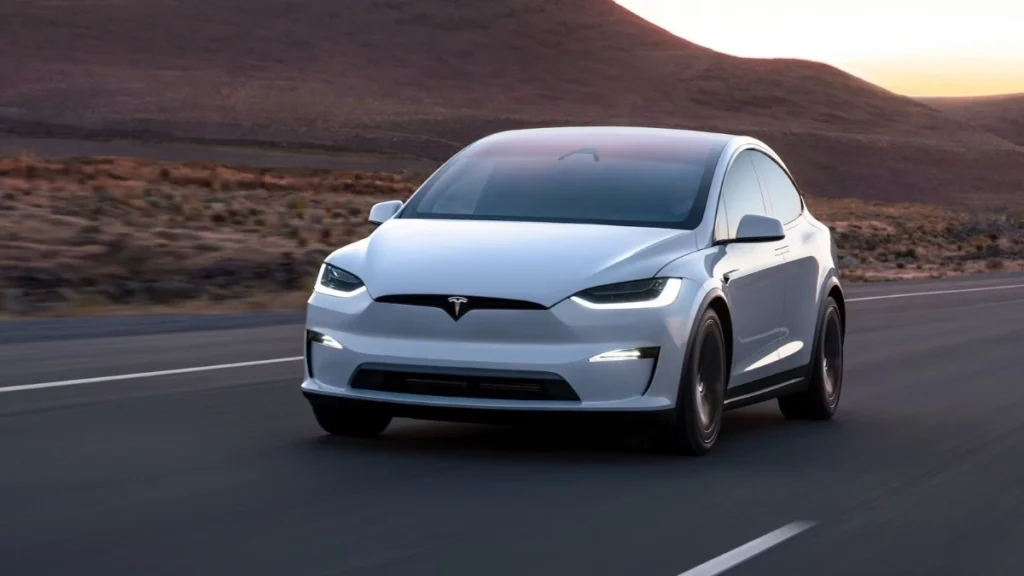
The Tesla Model X has always been in the news for its powerful performance and gullwing doors, but this time the 2026 Tesla Model X surprised everyone. When we tested it again, it looked the same at first glance, but weighing it revealed it had become approximately 400 pounds lighter. Everyone was curious to know how this change occurred over the past ten years, and so we discussed it with Lars Moravy, Tesla’s Vice President of Vehicle Engineering.
Moravy explained that initially the company wanted to bring the Tesla Model X to market quickly. In this hurry, many parts were taken from the Model S, which contributed to the weight gain. Over time, engineers reduced weight everywhere possible, and today’s Model X has emerged in a completely new form. He jokes that for every 1 kilogram of weight lost, he gives his engineering team a case of beer, and this time they distributed a lot of beer.

Battery and Motor: The Biggest Reason for Lighter Weight
The biggest change in the 2026 Model X is its battery and electric motors. Tesla converted the rear motor from an induction to a permanent-magnet design, reducing weight by approximately 100 pounds. The half-shafts were also improved to remove additional weight.
In the 2021 update, Tesla completely revamped the battery pack. The new cell technology is slightly more energy-dense, and the cells are positioned vertically instead of horizontally within the model. This eliminated approximately 300 cells from the battery pack and lightened the structure. This change reduced weight by approximately 90 pounds, while battery capacity remained roughly the same.
Surprising Weight Reduction in Interior and Wiring
It’s surprising to hear that despite the increased interior quality, Tesla managed to reduce weight by approximately 80 pounds. Many parts were made thinner, and some were manufactured using new technologies. Even parts of the airbag system were incorporated within the headliner fabric to reduce weight.

50 pounds were saved by eliminating the pedestal base in the five-seater variant, and the seat now folds flat easily. 11 pounds were reduced by eliminating the center mounting in the bucket seat variant. Changes to the seatbelt structure reduced another 6 pounds. High-voltage wiring was also optimized, replacing copper with aluminum wiring. This reduced weight by another 44 pounds. Simplifying the cooling system reduced an additional 30 pounds.
The Art of Engineering: Small Changes, Big Impact
“Tesla Model X is a work of art.”
— TESLA CARS ONLY⚡️ (@teslacarsonly) October 16, 2025
— Elon Musk pic.twitter.com/4tCph1VeFX
Moravy jokingly noted that the early Model X had a separate tank for the air suspension, while a similar structural component occupied the same amount of space. Now, in the new model, the air tank is integrated into that same structural component. This not only reduced weight but also slightly increased cargo space.
The company used megacasting in the front and rear structures. Where there were previously eight parts, four large parts were now installed. This reduced 20 pounds and increased the car’s rigidity by 10 percent. Tesla also upgraded the 12-volt battery to lithium-ion technology, reducing 14 pounds. The plastic in the front and rear fascias was made 0.6 millimeters thinner, reducing another 10 pounds. The 2026 Model X is Tesla’s first car to use a cast refrigerant manifold, which is three pounds lighter and more durable.
Overview
| Topic | Details |
|---|---|
| Model | 2026 Tesla Model X |
| Main Highlight | Almost 400 pounds lighter than the original 2016 model |
| Reason for Weight Loss | Major redesigns in battery pack, motors, interior, wiring, cooling and structural components |
| Key Engineering Changes | Permanent-magnet rear motor, vertical battery modules, reduced cell count, simplified cooling, megacastings |
| Interior Improvements | Better materials yet lighter design, redesigned seats, optimized airbag integration |
| Structure Enhancements | Larger megacastings, integrated air tank, thinner fascias |
| Additional Weight Reductions | Lithium-ion 12-volt battery, aluminum wiring, suspension tweaks |
| Overall Impact | Lighter, stronger, more efficient and better-packaged Model X |
FAQ
Q1. Is the 2026 Tesla Model X really 400 pounds lighter?
Yes, its weight has decreased by approximately 400 pounds after various engineering changes.
Q2. Did the battery change affect range?
The battery pack has changed, but the usable capacity has remained approximately the same, so there is not a significant difference in range.
Q3. Has the interior weight reduction reduced quality?
No, rather, the 2026 Model X’s interior is more premium than before. The weight reduction is due solely to design and material changes.
Q4. Has the use of Megacasting reduced the car’s rigidity?
On the contrary, the car’s torsional stiffness has increased by approximately 10 percent.
Disclaimer: This article is based on available information. Technical information provided by Tesla may change over time. Readers are advised to check the company’s latest updates or official website for any official confirmation.